
What score does your child
actually need?
For the SHSAT there is a real answer, published every year. For the TACHS and the HSPT there is not, whatever other sites tell you. Below is the honest version of both, and a checker that shows where a score stands.
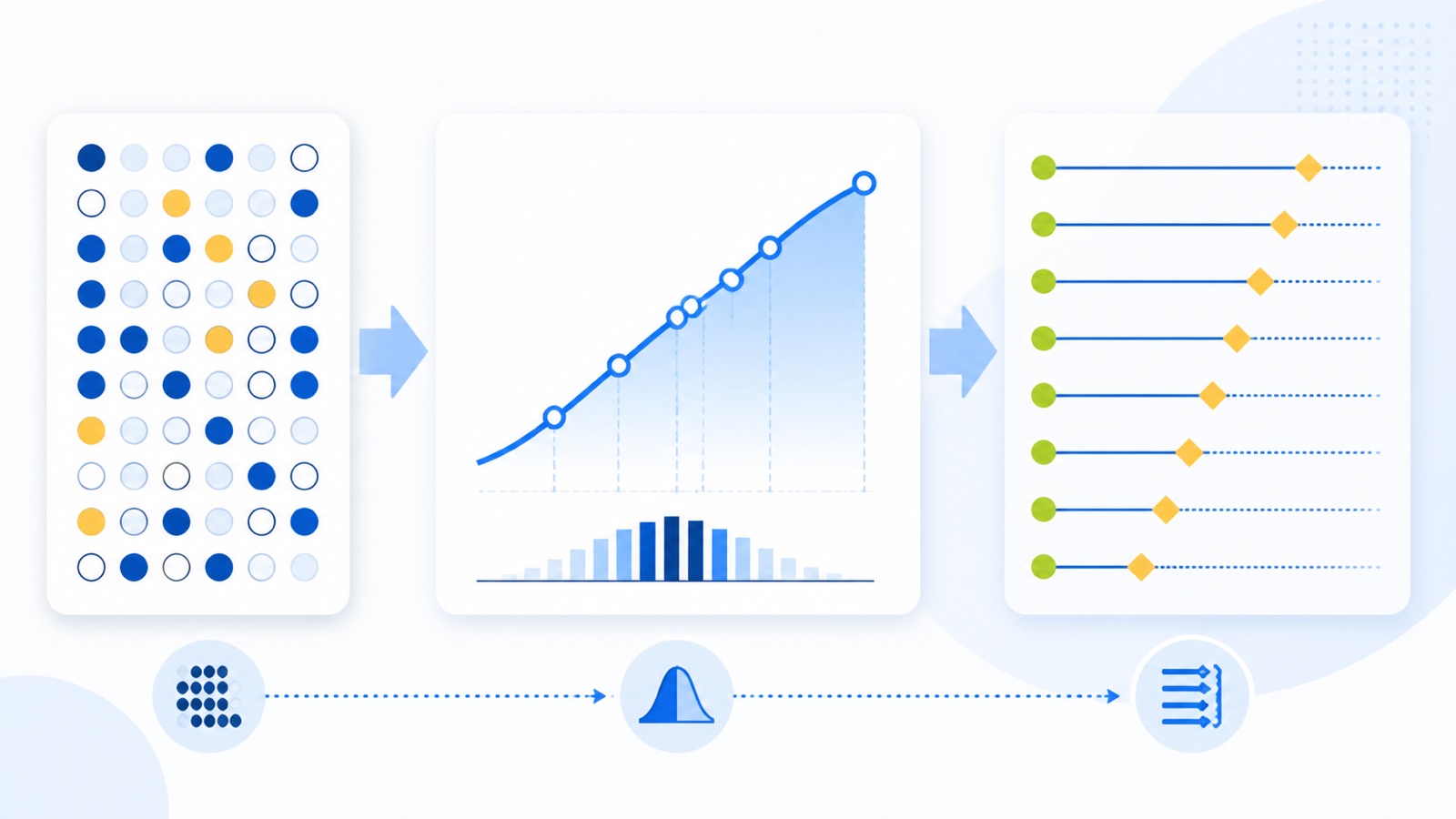
Drag the sliders. Watch what actually moves the score.
Set how many questions your child gets right, then change how hard those questions were, and watch the score swing by a hundred points without the number correct changing at all. That is what “adaptive” means in practice, and it is the single most useful thing to understand before October.
Nothing is stored and nothing is sent anywhere. It all runs in your browser.
The thing almost every other site gets wrong
There is no cutoff score for the exam your child is about to sit. Not because it is secret, because it does not exist yet.
The fall 2026 SHSAT is the first computer-adaptive administration. Its results turn into offers in March 2027, and only then does anyone learn what the cutoffs were. Every cutoff you can find online today, including tables labeled “2026”, comes from the previous 114-question format, sat in an earlier October.
That does not make the old numbers useless. They tell you how the eight schools rank against each other, roughly how far apart they sit, and how much the bar moves from year to year. It does mean that treating any single number as a target for the adaptive exam is a mistake, and that a site presenting one as settled is not being straight with you.
The 2026 cutoff for all eight specialized high schools.
These come from the New York City Department of Education’s admissions outcome reporting for the 2025 round. They are the most recent figures we can confirm against more than one independent source.
| School | Borough | 2026 cutoff |
|---|---|---|
| Stuyvesant High School | Manhattan | 561 |
| High School for Math, Science & Engineering at CCNY | Manhattan | 539 |
| Queens High School for the Sciences at York College | Queens | 531 |
| The Bronx High School of Science | Bronx | 525 |
| Staten Island Technical High School | Staten Island | 517 |
| High School of American Studies at Lehman College | Bronx | 507 |
| Brooklyn Technical High School | Brooklyn | 506 |
| The Brooklyn Latin School | Brooklyn | 495 |
What a cutoff actually is
It is not a pass mark, and nobody sets it in advance. Every student who sits the SHSAT ranks their schools in order of preference. Offers are then made from the highest score down, working through each student’s list until the seats run out. Whatever the last admitted student scored becomes that school’s cutoff for the year, and it is only known afterwards.
That is why the number moves. A year where more strong candidates put Stuyvesant first pushes Stuyvesant’s cutoff up, without anything about the school or the exam having changed. Across recent years the eight cutoffs have typically moved by a few points to around ten in either direction. Our checker treats anything within roughly fifteen points as borderline for exactly this reason.
Why we do not publish a fifteen-year table
Plenty of sites do, and they disagree with each other. Comparing two of the most widely cited compilations, one lists Stuyvesant at 559 for a given year and the other lists 566 for what appears to be the same year, their columns are offset. We are not willing to reprint figures we cannot reconcile and present them as settled fact, so we publish the year we can stand behind and say plainly why.
Ranking your schools matters as much as the score
Because offers follow each student’s own preference order, the list is a real decision, not a formality. A student can score above a school’s eventual cutoff and still not be offered a place there, simply because a school they ranked higher offered them a seat first. Rank the schools in the order you genuinely want them.
Why there is no TACHS cutoff list.
Catholic high schools in the Archdiocese of New York and the Diocese of Brooklyn and Queens do not publish score thresholds, and they do not admit on the test alone.
A TACHS report gives percentile ranks rather than a scaled composite, and the percentile is what schools generally look at. Broadly, the 70th percentile and above is the range schools describe as a competitive application, and the 90th and above is where the most selective schools and scholarship conversations sit. Below the middle of the range, admission remains realistic at many schools, and some use the score to plan academic support rather than to decide whether to admit at all.
That is genuinely as precise as the facts allow. Grades, written work and teacher recommendations carry real weight, and two schools can treat the same score very differently. If you find a table claiming to list TACHS cutoff scores school by school, it has been invented. The reliable answer comes from asking the schools on your list directly, they will tell you, and the question is a perfectly normal one to ask at an open evening.
The HSPT is a placement test as much as an admissions one.
Schools using the High School Placement Test rank students by percentile against everyone who sat it on the same date, and they use the result for three separate things: admission, course placement, and scholarships.
The percentiles that come up repeatedly are the 75th and above for a competitive application, the 90th and above for the most selective placements and merit award consideration, and the 96th and above where academic scholarships are awarded on test performance, with the largest awards at the 98th and 99th. At the other end, some schools ask students in the lowest band to complete a summer program before starting in the fall.
As with the TACHS, these are patterns across schools rather than published thresholds, and every school sets its own. Ask the schools you are applying to what they use the score for, particularly whether it affects which math class your child starts in, which matters more over four years than most families expect.
Find out where your child actually stands.
A number from a practice test is only worth something if the practice test matches the real one. Ours are built to the fall 2026 adaptive format: 50 ELA, 50 Math, three hours, difficulty adjusting question by question.
Start with ten real questions, free. No card, and the report comes to you rather than to your child.
What families ask about SHSAT cutoffs.
What is a cutoff score?
The score of the last student admitted to a school in a given year. It is not a pass mark set in advance. Every candidate is ranked, seats are filled from the top down, and whatever score fills the last seat becomes that year's cutoff.
Is there a cutoff for the exam my child is sitting now?
No, and this is the thing most sites get wrong. The fall 2026 SHSAT is the first computer-adaptive administration. Its results turn into offers in March 2027, and only then does anyone learn what its cutoffs are. Every published cutoff comes from the earlier paper format.
Does the DOE publish a cutoff table?
No. The Department of Education tells each student their own result. The per-school tables you find online are compiled by others, which is why two of them can disagree about the same year.
Why don't you publish fifteen years of cutoffs?
Because third-party compilations of the earlier years disagree with each other about which score belongs to which year, and we are not willing to present figures we cannot reconcile as though they were settled.
Does the checker send my child's score anywhere?
No. The tool runs entirely in your browser. Nothing is transmitted, stored or logged, and it works with no account.
Can a practice score predict an offer?
No. A practice score tells you where a child stands today against the questions we wrote. Past cutoffs are context for reading that, not a target to hit, and they describe a different exam format.