
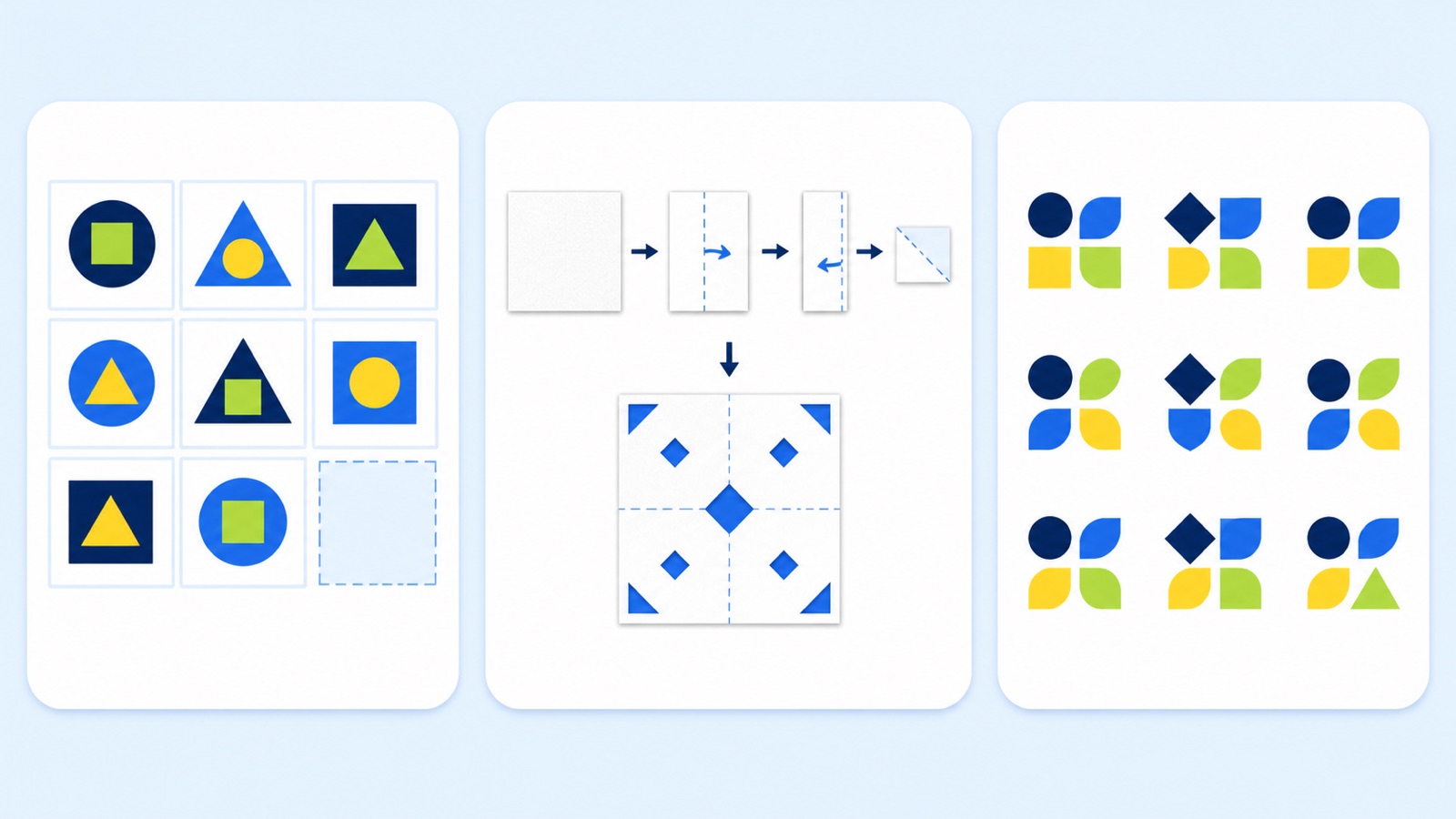
What the three sections are
Fifty of the TACHS questions test abstract reasoning rather than anything on a curriculum: 17 figure matrices, 16 paper folding and 17 figure classification.
Figure matrices
A grid of shapes with one cell missing. The student works out the rule that governs the grid and picks the shape completing it.
The rules are drawn from a small set: rotation, reflection, a count that changes, shading that alternates, a shape that gains or loses a feature. Almost every matrix is one or two of those combined. A student who knows the list looks for the rule; a student who does not simply stares.
Paper folding
A square of paper is folded, holes are punched, and the student picks what it looks like unfolded. This is the section that most often defeats otherwise strong candidates, because it rewards spatial visualization that is neither taught nor tested anywhere else.
The practical method: work backwards, one fold at a time, and remember that each unfold mirrors the holes across the fold line. Doing it with a real piece of paper two or three times fixes the idea far faster than reading about it.
Figure classification
Three shapes share something. The student picks the fourth that belongs with them.
The trap is settling on the first thing the three have in common. Frequently two candidate answers share a superficial property and only one shares the property that actually links all three. Naming the rule out loud before looking at the options is the habit that fixes this.
Why these are the best-value marks on the exam
Reading comprehension improves over years. Abstract reasoning question types can be learned in two weeks, because the gain is familiarity rather than knowledge. For a student with limited preparation time, these fifty questions are where an hour goes furthest.
Practice with explanations, not just answers
An answer key is nearly useless here. Knowing the answer was the third option teaches nothing; knowing that the rule was rotation, not reflection teaches the rule.
Every wrong option on our TACHS practice exams carries its own explanation naming the specific error. See the style in ten free questions.
Practice the real thing
Our TACHS exams are full length and written from scratch — every wrong answer carries its own explanation, so you can see what went wrong and why. Ten questions are free, with no account and no card. After that it is five credits an exam.